
EMR vs EHR: Does the Difference Matter for a DPC Practice?
Officially, an EMR (electronic medical record) is a digital version of the paper chart inside one practice, and an EHR (electronic health record) is designed to share that information beyond the practice, with labs, specialists, hospitals and the patient. That's how the federal health IT office has drawn the line. In practice, vendors use the two words almost interchangeably, so for a direct primary care practice choosing software, the label tells you very little and the features tell you everything.
This page covers where the definitions come from, how DPC vendors actually use them, the one place the difference has real teeth (certification), and what to look at instead.
The official definitions
The clearest statement of the difference comes from ONC, the Office of the National Coordinator for Health Information Technology, which now sits within HHS's Assistant Secretary for Technology Policy (ASTP). In a post on HealthIT.gov, ONC explained that it uses "electronic health record" almost exclusively, and why.
In ONC's framing, an EMR is "a digital version of the paper charts in the clinician's office," containing the medical and treatment history of patients in one practice. It lets clinicians track data over time, see who is due for screenings and monitor quality inside the practice. The weakness ONC pointed to is that the information "doesn't travel easily out of the practice."
An EHR, in the same framing, does all of that and more. It focuses on the patient's total health and is "built to share information with other health care providers, such as laboratories and specialists," so the record can move with the patient to a specialist, a hospital or another state. ONC also stressed that EHRs are designed to be accessed by everyone involved in the patient's care, including the patient.
| EMR (official sense) | EHR (official sense) | |
|---|---|---|
| Scope | One practice's chart | The patient's wider health record |
| Main use | Diagnosis and treatment | Care across settings |
| Sharing | Hard to move out | Built to share |
| Patient access | Not central | Expected |
That ONC post was written in 2011. The definitions still hold, but nearly every cloud chart sold to DPC practices today can share at least some data, so the clean line it describes has blurred.
How DPC vendors actually use the words
Read a few vendor sites and you'll see the terms used by habit more than by definition. Hint describes its charting product as an EMR (its documentation tool, for example, "requires EMR & Practice Management"). Akute calls itself "an Automation-First EHR," and Elation talks about its "EHR Pricing." SigmaMD describes itself as an "all-in-one EMR" for concierge medicine.
None of those word choices tells you that one product shares data more widely than another. They tell you which term each company's marketing team prefers. On this site we say EMR most of the time simply because it's what most DPC doctors type when they search, and we mean the same thing either way.
If you're comparing products, put the label aside and look at what each one does. Our best DPC EMR guide compares the main options on charting, memberships, ePrescribing and published price.
Where the difference has real teeth, certification
There is one place the "EHR" idea carries formal weight, and that's federal certification. ONC runs a certification program for health IT, and certified products have to meet specific criteria, many of them about sharing data. One example is an export requirement. Certified products that store patient data must let users export a single patient's electronic health information, and the whole patient population's, in a computable format with publicly documented structure.
Certification matters most to clinicians reporting to Medicare's Merit-based Incentive Payment System (MIPS). Its Promoting Interoperability category requires certified EHR technology, and clinicians report their product's certification ID when they submit. A DPC practice that doesn't take part in MIPS usually won't feel that requirement, but if you see some Medicare patients under a hybrid model, or might in the future, ask each vendor whether its product is certified and for which criteria.
Certification is also a decent proxy for one thing DPC doctors do care about, which is getting your data out if you ever leave. Even if a product isn't certified, ask the same question. How to switch DPC EMRs explains what a full export should include.
Why the label barely matters when you choose DPC software
A DPC practice uses its software differently from an insurance-based clinic. You aren't coding visits for claims, and your revenue depends on memberships staying active and members feeling they can reach you. Those needs don't map onto the EMR versus EHR distinction at all.
Here's what the EHR label seems to promise, next to what you should actually check in a demo.
| The label suggests | What to check instead |
|---|---|
| It shares data | Which labs have live two-way interfaces |
| It reaches other clinicians | How outside records and faxes get filed |
| Patients can see their record | What the portal looks like as a member |
| It's complete | Whether memberships live on the same record |
| It's modern | How many clicks a quick visit takes |
Price follows features, not labels, too. Among published prices checked on each vendor's site in November 2026, the products that call themselves EHRs range from Akute's Essentials plan at $300 a month for one clinician and 100 patients to Elation's Standard DPC plan at $375 a month per provider, while Hint's Launch plan with its EMR is $290 a month for one clinician and unlimited members. The word on the box doesn't predict where a product falls.
Where sharing really does show up in DPC
The idea behind the EHR definition, that information should follow the patient, is still worth caring about. It just shows up in specific, testable places rather than in a product's name.
Outside records are the big one. When a member sees a specialist or ends up in the emergency department, you want those notes in your chart quickly, and in many practices they still arrive by fax and wait for someone to file them. Lab results are another, since a live interface puts results straight into the chart while a portal download means retyping. ePrescribing is a third, because refill requests from pharmacies should land where you'll see them.
When these pieces don't connect, it's not a failing of your team. Most of these tools were simply never built to talk to each other, which is why the questions in our DPC EMR demo checklist focus on exactly these connections.
Our take
The EMR versus EHR distinction is real in the federal definitions and in certification, and it matters if you report to Medicare's quality programs. For almost every other DPC decision, it's a vocabulary question. Pick the system that makes a real visit feel short, keeps memberships and the chart in sync, connects to the labs and pharmacies you use, and lets you take all your data with you, whatever it calls itself.
The part most guides skip
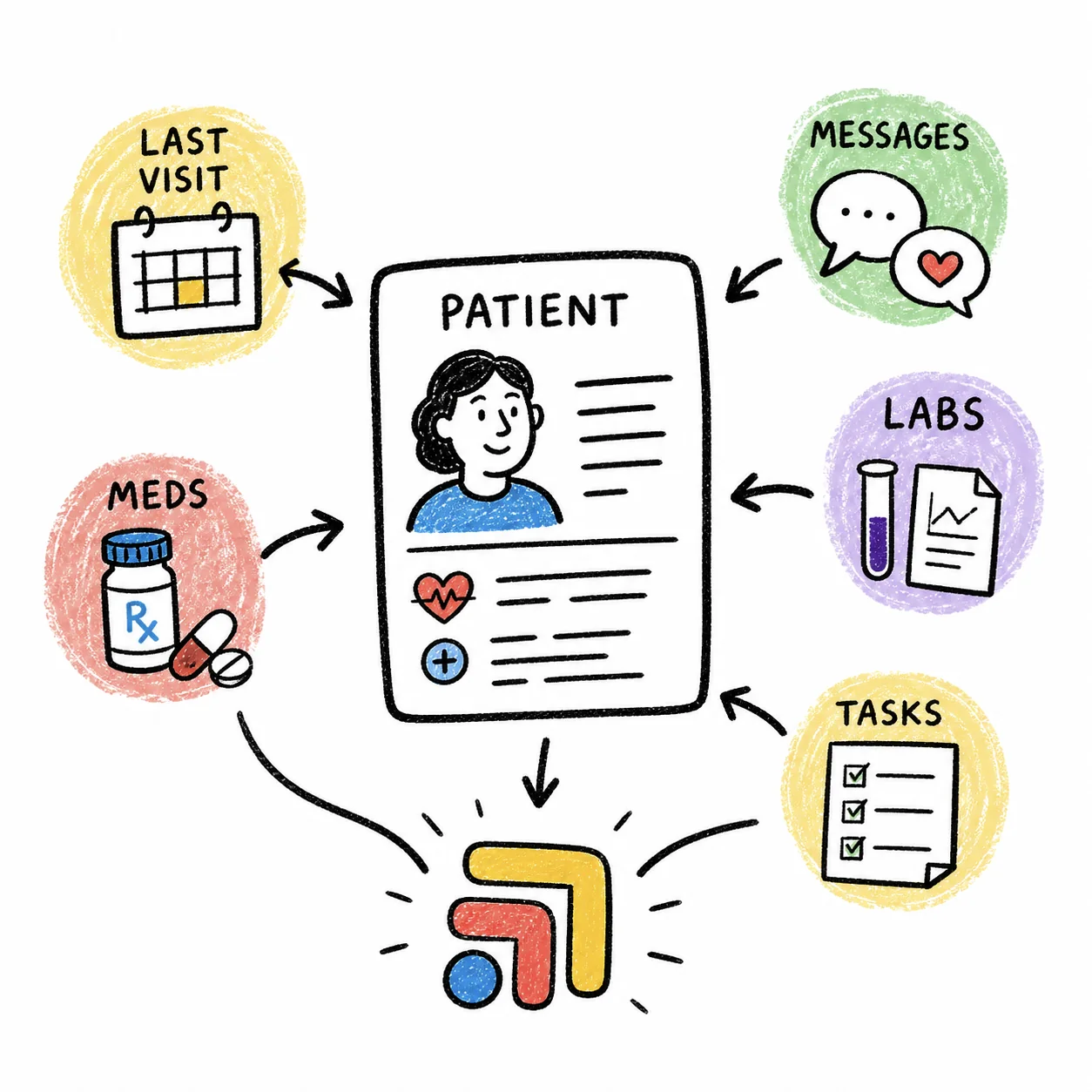
Every tool in a DPC clinic is good at its own job, and none of them were built to talk to each other. A patient text turns into a refill in the chart, which needs a review, which needs a reply, and the follow-up lives in someone's head. That isn't anyone's fault. The tools just don't share a to-do list.
That's the job Tabflows does. Tabflows is a dedicated tech team for DPC clinics. We connect the tools you already chose and give your team one place for chat, tasks and patient context, with managed workflows for the repeat work like refills, lab follow-ups and onboarding. You keep every tool you picked.
Frequently asked questions
What is the difference between an EMR and an EHR?
In the federal government's usage, an EMR (electronic medical record) is a digital version of the paper chart in one practice, while an EHR (electronic health record) is built to share information beyond that practice, with labs, specialists, hospitals and the patient. In everyday use, most vendors treat the two terms as the same thing.
Is an EHR better than an EMR for direct primary care?
Not because of the label. What matters for a DPC practice is how fast the chart is, how memberships and billing work, what ePrescribing and lab interfaces cost, and whether members can reach you easily. Judge each product on those, whatever it calls itself.
Does a DPC practice need a certified EHR?
Certification mostly matters for clinicians reporting to Medicare's Merit-based Incentive Payment System, whose Promoting Interoperability category requires certified EHR technology. Many DPC practices don't take part in that program, but if you do, or might, ask each vendor about certification before you sign.
Why do some DPC vendors say EMR and others say EHR?
Mostly habit and marketing. Hint, for example, describes its charting product as an EMR, while Elation and Akute describe theirs as an EHR. The words don't reliably tell you what the software can do.